
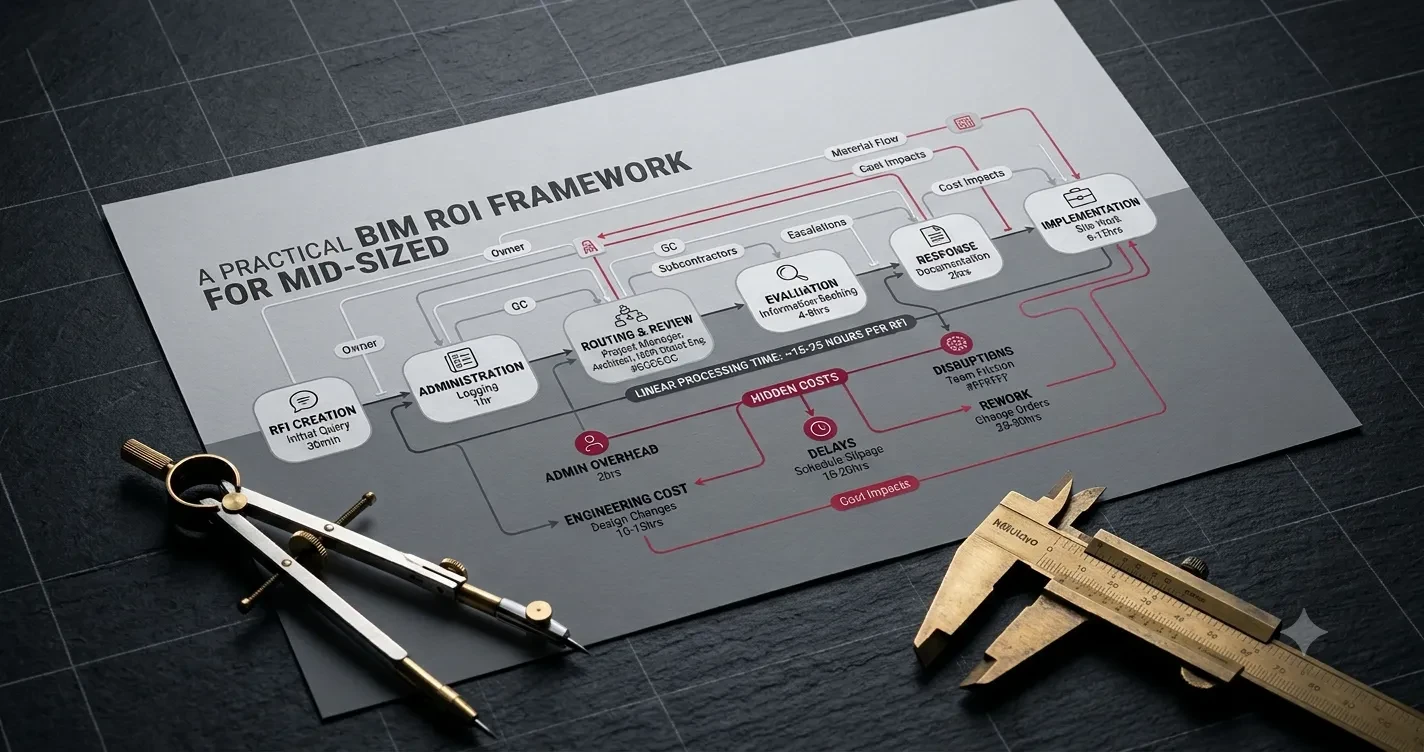

The Hidden Cost of RFI Overload in Execution
Most site delays aren't caused by supply chain bottlenecks—they stem from silent clashes lingering inside uncoordinated 3D models.
During a recent multi-disciplinary execution phase, field teams faced mounting friction. Structural layouts and MEP ductwork collided repeatedly during site installation. Instead of maintaining momentum, engineering leads suffered acute RFI overload. Requests for information piled up daily, holding back concrete pours and creating severe trade friction on site. The core issue wasn't field incompetence; it was bypassing thorough pre-construction clash detection.
Resolving this required assembling a cohesive federated model governed by a clear BIM Execution Plan (BEP). By establishing methodical Navisworks review sessions prior to site release, our team identified critical spatial interferences early. Clarifying LOD 300 vs LOD 400 scope boundaries eliminated ambiguity before drawings hit the field. Synchronizing Architectural, Structural, and MEP drawings into unified Good for Construction (GFC) drawings ensured every contractor executed from a single source of truth.
Key execution takeaways:
• Prioritize multi-disciplinary clash resolution before issuing site documentation.
• Standardize federated model checks to intercept spatial conflicts digitally.
• Shift coordination friction into virtual pre-construction where fixes cost virtually nothing.
Pre-construction digital engineering exists to protect site productivity. Resolving interferences in a virtual model is always significantly cheaper than chipping away poured concrete.
How is your team managing clash resolution prior to issuing GFC drawings?